When the Encore Ends: What Happens to a Superstar's Choker After the Lights Go Down

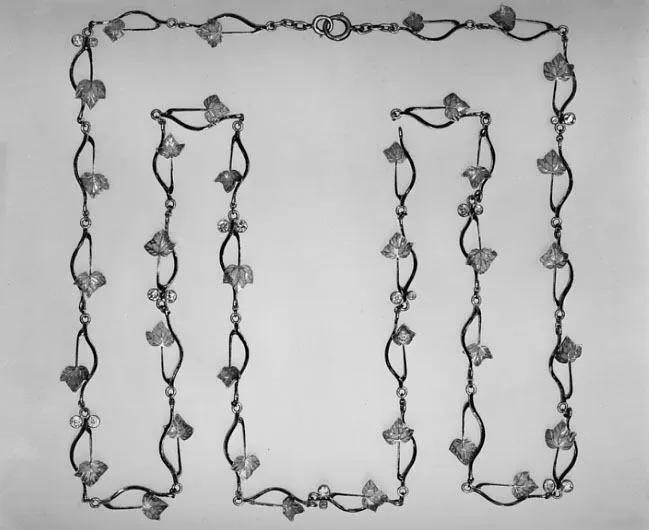
Photo: Oppi A. J. Untracht, Public domain, via Wikimedia Commons
There's a moment at the end of every arena tour that fans never see. The confetti's been swept up, the road cases are labeled and loaded, and somewhere in a backstage drawer sits the jewelry — thousands of carats of stage-worn diamonds that just sang along with 60,000 people a night for five months.
Most of it goes back to the stylist. Some of it goes back to the jeweler. But every so often, a piece goes somewhere else entirely: to an auction house, under glass, with a placard that reads worn onstage.
And when that happens, the price can get strange in a hurry.
The Choker That Rewrote the Rules
Ask anyone in the memorabilia business about the moment stage jewelry became serious business, and they'll point to the choker. A six-figure diamond collar, custom-made for a single tour, worn during the opening number of what became one of the most-bootlegged broadcasts of the decade. When it surfaced at auction a few years later, the estimate was aggressive. The final price blew past it.
"People weren't bidding on the stones," one auction house specialist told us, speaking generally about the category. "Comparable diamonds, no provenance, you're looking at a fraction of that. What they were bidding on was the night. The performance. The moment everyone remembers."
That's the core math of stage-worn jewelry: the diamond is the down payment, but the provenance is the payoff.
Provenance Is the Real Carat Weight
Auction specialists talk about provenance the way gemologists talk about clarity — as a grading scale. And on that scale, not all stage time is created equal.
A piece worn across an entire tour? Valuable, sure. But a piece worn during one specific, legendary performance — a awards-show shocker, a farewell show, the night a surprise guest walked out — that's where values multiply. "A single documented performance can be worth more than a hundred ordinary ones," the specialist explained. "Scarcity plus story. Collectors respond to both."
Documentation is everything. Photos from the broadcast, styling credits, receipts from the jeweler, even backstage Polaroids — auction houses will build entire files around a piece before accepting it. If the chain of custody has a gap, the estimate gets a haircut. If it's airtight, the phone bids start early.
Collectible or Curiosity? It Comes Down to Three Questions
Not every rhinestone-adjacent relic makes the cut. Specialists we spoke with tend to ask the same three things:
1. Can you see it in the footage? If the piece is visible in the moment people actually remember — the close-up, the key change, the curtain drop — it's part of the cultural record. If it's buried under a jacket sleeve, it's inventory.
2. Does the artist still matter to that moment? Jewelry tied to a career peak or a turning point holds value. Jewelry from the forgettable middle of a tour does not.
3. Is there a paper trail? Tour archives, stylists' invoices, a mention in a liner note. The boring paperwork is what makes the exciting price possible.
Pass all three, and you've got a collectible. Fail one, and you've got a very expensive curiosity.
The Fan Economy Meets the Fine Jewelry Market
What's changed in the last few years is who's bidding. The traditional memorabilia buyer — the archive-builder, the museum — has been joined by a younger collector who treats a stage-worn pendant the way earlier generations treated a signed guitar. It's merch culture with a gemological certificate.
Auction houses have noticed. Several now stage dedicated entertainment-jewelry sales, complete with performance footage looping on screens above the lot. The theater is deliberate. You're not just buying a stone; you're buying a seat in the story.
And the artists have noticed too. Some now commission pieces with the afterlife in mind — knowing that a documented debut tonight is an auction headline in five years. One stylist described it bluntly: "We're not just dressing a tour. We're dating the lots."
The Hammer Falls, the Sparkle Stays
There's something a little poetic about the whole thing. The diamond outlasts the tour, the setlist, even the era. It sits in a case with a video playing overhead, and for ninety seconds, a bidder relives a night they maybe watched from the cheap seats or a livestream at 2 a.m.
The lights go down on every tour eventually. But for a handful of very lucky stones, the spotlight never dims — it just changes venues.
Diamonds Unleashed will continue tracking the entertainment jewelry auction circuit as major sales are announced this year.